Opinion by Linus Höller*
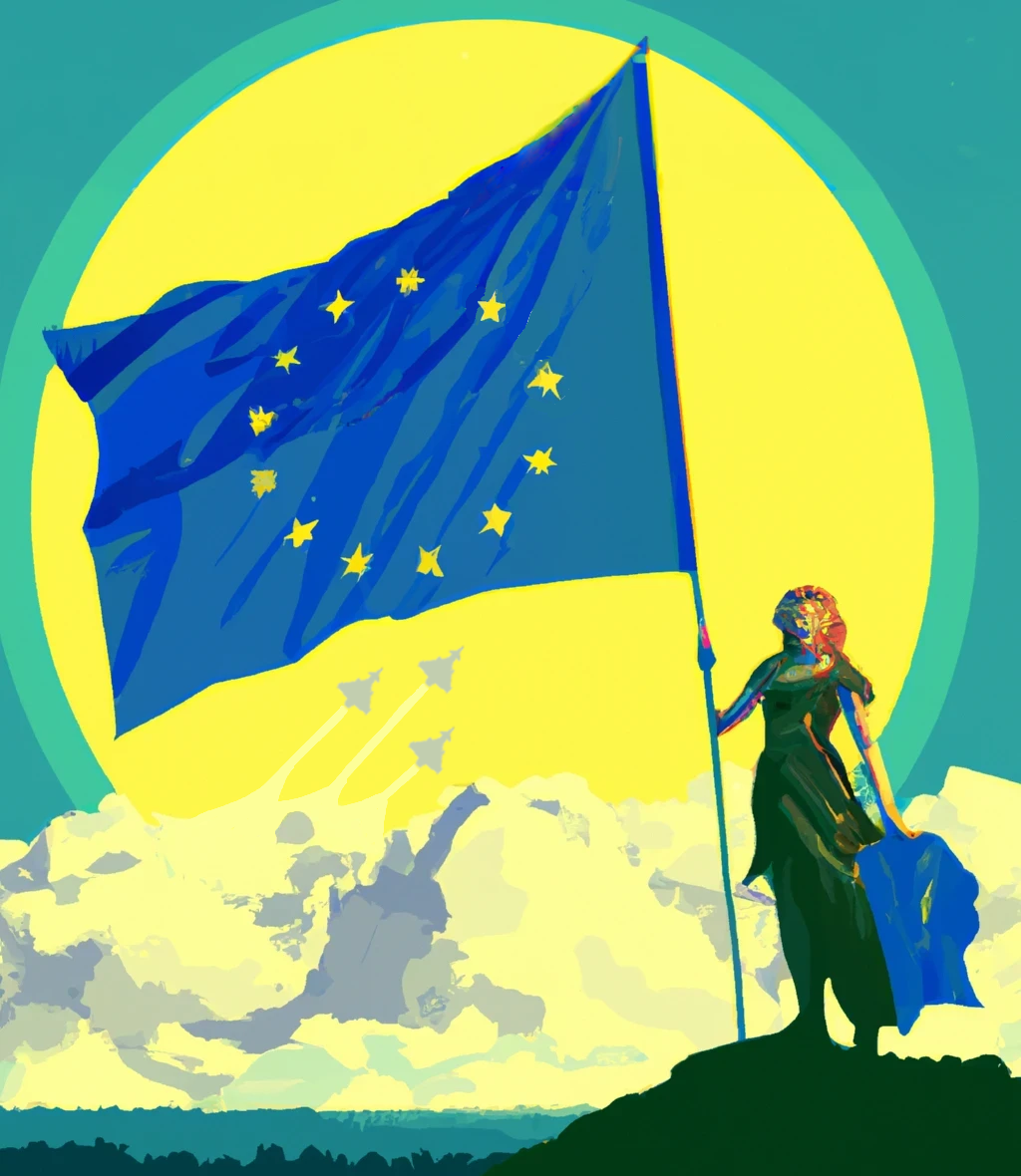
Title image by Reddit user u/JLXuereb
The world has entered a new era, and those clambering desperately to the way things were before are doing so in vain. Among the chaos and violence of the new world order in the making – one strikingly alike the Kremlin’s long-professed prediction of a multipolar world, where might makes right – one gleaming exception arises: the European Union.
The EU is far from perfect. But it is the best the world has to offer right now, and it serves as a stronghold of democracy and liberal ideals such as justice, rights and freedom in an increasingly hostile world. It finds itself at a once-in-history moment when it could replace the United States as the global normative lighthouse.
Historically, it has been the U.S. – itself far from perfect but outwardly committed to a set of admirable and noble principles – that has held this position as the global arbiter of what is right and wrong and the setter of global standards. Not purely by virtue of the goodness of its ideas, of course; it was and still is by far the world’s most capable military and was a victor in both world wars. But the bygone American dream and the values of liberty, justice, and prosperity associated with it by people around the world, along with a certain glamor and shine, unquestionably played an immense role in shaping the country’s public perception and its ability to influence norms worldwide.
The U.S. has abdicated this role.
Alternative models and why Europe’s is best
Alternative models exist. For one, there is the Trump-Kremlin style of authoritarian neo-fascism centered on ultra-conservative values, the ham-fisted power of weapons, and a corrupt, oligarchic state. Then there is the Chinese model, built on supercharged state capitalism and absolute control by a single party. It excels at building flashy things quickly (and arguably must do so to survive), but at the expense of all meaningful individual liberty and a social fabric.
The third way is for which the European Union stands. Europe is by far the most prosperous, livable and safe continent. The quality of life across the board is unmatched by any other region. The political consciousness – although challenged by an extremist right-wing fringe – is built on participation, predictability and, by and large, on morality. The rule of law is effective and just, protecting the rights of people as individuals and a collective, rather than serving to extend a shielding hand over unchecked capitalism or letting itself be instrumentalized for partisan causes. Government acts to protect consumers and make lives better in small but meaningful ways – no roaming fees, strong passenger rights with airlines and train companies, the right to live and work anywhere in the Union, strong privacy and data protection laws, and the list goes on and on. Europe is the unambiguous center of international justice and humanitarian law: The International Criminal Court and the International Court of Justice are located here, along with several UN headquarters and offices, plus the Red Cross; bulwarks of arms control and disarmament like the atomic energy agency, biological and chemical weapons conventions are centered here. Europeans get free education and guaranteed, high-quality public health insurance that isn’t tied to their job and that additionally beats many private plans in the rest of the world for coverage. European work-life balance is unmatched – the average salary in Spain, oft-mocked for its siesta culture, and South Korea, known for unforgiving working conditions and pressure, are similar. And Spain isn’t even one of the richest ones on the continent.
Of course, there are people who suffer in Europe, too. To name just one category: Poverty is a huge issue anywhere it exists, and should be a public policy priority to eliminate. These challenges are real and urgent, but don’t negate Europe’s relative success in providing quality of life, and as such are not the focus of this piece.
We need to own our accomplishments
European governments, especially in recent decades, have been remarkably poor at communicating their successes to domestic audiences, let alone to international ones. But this needs to change to seize the moment. The world is leaderless in a moral and normative sense right now. Not Washington, Beijing and definitely not Moscow can fill this gap. The only ones who can are the Europeans, together with their close companions in places like Canada, New Zealand and Australia.
The billions of people who used to aspire, in more or less real and realistic ways, to emigrate to the U.S. to benefit from all the promises of the idea of America haven’t disappeared. They are a formidable global force. That Europe can take this place is evident in the millions of people who have sought to migrate to the continent in recent history. Europe is positioned like no other to offer an alternative model for the masses and the leaders of the world to aspire to.
In some ways, this has already succeeded. For instance, Europe is a regulatory standard powerhouse. Taken together, the continent is, by some measures, the world’s largest economy, and when Europe enacts standards and laws that protect consumers, much of the world follows suit either explicitly (by enacting their own similar laws, as is often the case for instance in California), or de facto (see the USB-C port on the iPhone, which was the result of EU action). It is also a global leader in climate action, both in talk and in action, a role that is increasingly a unique selling point at a time when millions of people are feeling the real, disastrous effects of global warming.
Now Europeans need to expand this into norms-setting power and stand up for their (liberal) ideals around the world, and use the sticks and carrots in their arsenal to encourage adherence to international law, norms and standards. This is not only the right and sound thing to do, as it will make the world a better place. But it is also crucial for self-preservation. Europe and its liberal democracy are safer in a world with other liberal democracies that it can cooperate and trade with and that will have its back as it has theirs. European countries have benefited greatly from the rules-based world order, and the EU, as an ambitious peacebuilding effort, is a direct result of people truly believing that international relations are not necessarily a zero-sum game and then acting accordingly. This flies right in the face of the might-makes-right types in Trump, Putin, Xi and co.
What needs to be done
The continent, preferably collectively, must throw its whole weight behind supporting its worldview globally. History has shown that people tend to want to live in freedom and prosperity (shocker, I know). Europe is rich, powerful and influential and must leverage these fortunate attributes for the grand goal of centering it in global norms-setting.
It needs to fund civil society and education. It must strengthen and make more resilient the democracies at home and those of its partners, sharing experiences and practices. It must push harder to export its consumer protections and expand the measures that positively affect everyday people, then take the credit for it. It needs to create, distribute and push propaganda (or public diplomacy, if that word makes you queasy) in favor of the rules-based world order and liberal project, both subtle and obvious. It also needs to stand prepared to apply said rules-based order equally to all players – no more measuring Russia and the U.S. on different scales for the same violations. It needs to reignite and channel a sense of aspiration toward a brighter, social democratic future. It must pound on the adherence to international treaties and find the guts to enforce them with all means necessary. It must be a bulwark of international arms control and disarmament efforts to make the world a safer place and build trust, while not being naïve. Individual countries’ diplomatic corps should leverage their special connections with parts of the global South to convince those countries of the value of siding with Europe over the alternatives. It needs to convince both with deeds and with words. It needs to ensure that its actions on the world stage benefit the people of the countries it interacts with just as much as Europeans. It needs to come to grips with how to deal with immigration pressures that will continue, and how to channel them in constructive ways that serve both the people seeking a better future and the continent they hope to find refuge in and contribute to. Europe must stand as a bulwark of reason and science (which in itself comes with huge benefits in attracting talent and economic progress). It must exalt education as something worth striving for and make it both financially attainable and cool, countering the anti-intellectualism emanating from the United States. It needs to fight that the concepts of freedom, justice and prosperity become the self-evident goal to strive for, and ideologies and models that run counter to it – American and Russian fascism, and even Chinese state capitalism – once again become justified pariahs on account of their demerits.
All this to say: Europe must show by doing and by saying it explicitly that the liberal, democratic, European world order is the one for the people of the world to aspire to.
The prime time to act is now – the clock is ticking, but it is not yet too late.
*Linus Höller is a Berlin-based Europe Correspondent covering defense, security and geopolitics. An Austrian by birth, he has lived on four continents and in seven countries. He holds master’s degrees in international relations, nonproliferation and terrorism studies and a bachelor’s in journalism, political science and international studies. He also serves as an advisor for the Organisation for the Prohibition of Chemical Weapons.


Linus’s thesis is sympathetic for any bleeding-heart liberal internationalist reeling from the de-facto degradation of the liberal rules-based international order first by Russia’s invasion of Ukraine (and the reverberations it has for future violations of sovereignty) and second (and perhaps more importantly) by Israel’s impunity in its genocide of Gazans. To become a guiding political exemplar for the world at large, Europe must first reckon with this geopolitical reality and its own responsibility in enabling its worst excesses, namely Germany’s, France’s, Italy’s (and non-EU member Britain’s) exports to the State of Israel (which is hardly a “bearer” of constitutional values; Israel 1. does not have a formal constitution and 2. has a segregated judicial system). Europe must also distance itself the best it can from American foreign policy whether it be Trump or Biden (as both refused to reign in Israel), despite its deep and historic integration with Atlanticist military and economic power post-WW2 through NATO, the Marshall Program and Intelligence Collaboration. Notwithstanding its own supposed moral excesses (I would cite 1. the flippant Macronist overturning of the electoral victory of the French Popular Front, 2. Certain digital privacy initiatives that ratchet domestic authoritarianism not unlike those in the Anglo-sphere and 3. The EU’s border regime that is embedded in the export of violence, militarization and instability to deter migrants), the EU must confront its perceived hypocritical moral standing amongst the countries of the Global South and Non-Western World; I suggest sacking Von Der Leyen and having countries do a complete reconsideration of its Israel policy (which would require re-scrutinizing its southward facing policy). As for Ukraine, the EU’s own support and apologia for Israel’s genocide in Gaza is used as a cudgel, rightful or not, against the EU’s own claims of morality and internationalist defense of sovereignty. If there is any defense of a rules-based sovereigntist international order to be had, it must be with the sober acknowledgement, whether it is pragmatic, strategic, or moralist in argumentation, that the EU’s support of Ukraine and its absence to challenge Israeli impunity (according to international law and the international agreements of the Oslo Accords) shatters its credibility. Whilst Russia is an increasingly paranoid and authoritarian state (long dominated by oligarchs even before Putin), The EU must weigh the moral realities of Ukraine and the immediate and long-run effects of Russian economic sanctions and re-militarization under their war economy. Making consistent the EU’s response to the Russian Invasion either by delinking with Israel or Ukraine will determine its diplomatic standing and its subsequent future as a guiding political and moral power of the globe. There are certainly trade-offs; but if Linus’s vision is to be advocated and even implemented, a realistic, likely pragmatic (and hence perhaps immoral) compromise will have to be made. For the Chinese, I believe the EU should stand firm on its human rights commitments (on the Uyghurs) even if hypocritical, but they should not economically antagonize or delink them like the Dutch have with Nexperia. Whilst China’s domestic political structure is hardly democratic or liberal, its foreign policy and trade relations remain firmly rooted in the maintenance of the international order, ever since its induction into the World Bank. China historically has not engaged in regime change, preferring to engage with the already-existing internationally recognized nation-states of the world for legal and economic reasons. Even if China prefers certain domestic actors around the world (ie, the Sinhalese state over the Tamil Tigers, the Tatmadaw over Democracy Protestors, etc), for problems with China the EU should not seek decoupling through moral denunciation (even if righteous) but rather collaborative, negotiated and political ones that address both ongoing crises in the world at large. Might I note that despite China’s aggressive rhetoric towards Taiwan, Taiwan remains closely economically integrated with China. Combined with close economic and regional ties to countries like South Korea (but less so with Japan), I believe peace will prevail in the short term despite American predilections to challenge China. To close, I believe Linus’s analysis could be clarified by asking which “Global South” countries he envisions European collaboration with, and by doing the hard, moral calculus on the pressing diplomatic issues of current European partnership with the United States and its increasingly militarist outlook, and its own support of Ukraine (via specific partners like France, Germany, etc) in comparison to its diplomatic and military support of Israel, because that would be the issue of hesitance.